
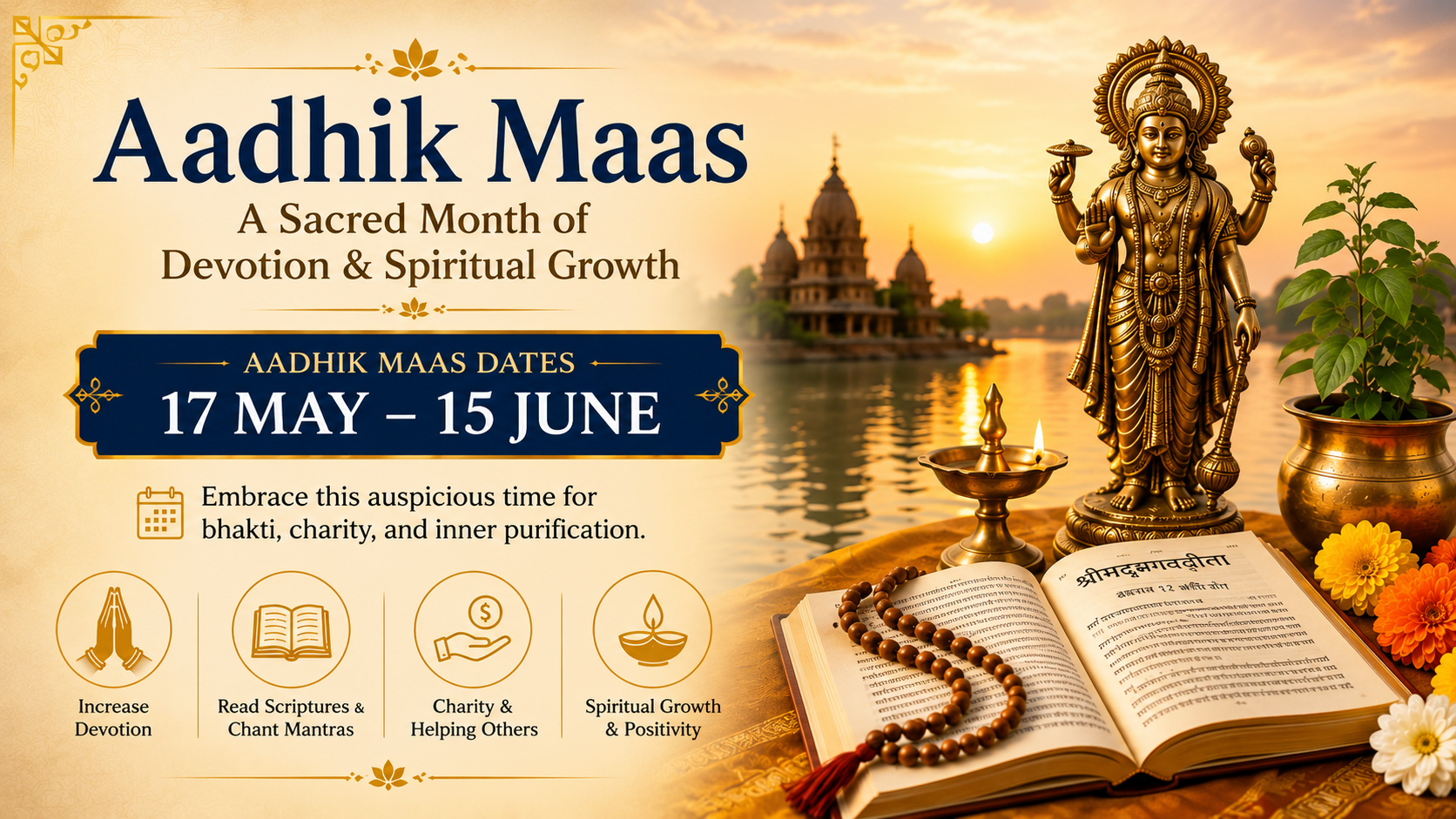
Once every three years, one of the lunar months becomes an Aadhik Maas (extra month). Typically this falls every 28 to 35 months, and by a known rule the same month repeats as aadhik every 19 years. The previous Aadhik Jyeshtha occurred in 2018; the next falls between 17 May and 15 June 2026.
The Hindu lunar year of twelve months (Chaitra, Vaishakha, Jyeshtha …) totals 354 days, eleven days shorter than the 365-day solar year. To keep the lunar calendar aligned with the seasons, an extra lunar month is inserted whenever a chandra-masa passes without a solar rashi-sankramana (sun-sign transit). Such a month is called Aadhik Maas — also Malmas ("impure month") or Dhondamas. Because its presiding deity is Bhagavan Shri Krishna, it is reverently named "Purushottam Maas".
During Aadhik Maas, devotees observe vratas dedicated to Sri Purushottam: month-long fasting, ayachit (eating only what is offered without asking), eka-bhukta (a single midday meal), nakta-bhojan (eating only at night after a daytime fast), and mauna-bhojan (silent meals). Those unable to keep the full month may observe one of these for three days, or even one day. Other recommended acts: tambul-daan for prosperity, lighting an akhand-deep before the deity for Lakshmi-prapti, a single Ganga-snan for pap-nivritti. Sri Vishnu-yag and Sri Satyanarayan Puja are encouraged. On specific tithis (Shukla and Krishna Dvadashi, Purnima, Krishna Ashtami, Navami, Chaturdashi, Amavasya) and on Vyatipata or Vaidhriti days, perform apoopa-daan — gifting thirty-three anarse. Those for whom this is not possible may offer thirty-three battasha instead. The intent: ayushya, arogya, aishvarya, and punya.
Nitya and Naimittik karma should be continued. Kamya karmas should neither be begun nor concluded in this month. Punah-pranapratishtha of deity murtis is permitted. Grahan-shraddha, jatakarma, and namakarma sanskars are allowed; tirth-shraddha, darsh-shraddha, and nitya-shraddha may be performed. Gruharambh, vastu-shanti, sannyasa-grahan, new vrata-grahan, vivaha, upanayana, choula, and new deity pratishtha should NOT be undertaken. However, sakharpuda, baarse, dohaaljevan, jaaval, laukik gruhapravesh, purchase of a new vehicle or property, and starting a new business are all permitted.
Aadhik Maas & Shraddh
The Aadhik Maas after this one will be Aadhik Chaitra, falling between 16 March and 13 April 2029.
— Mohan Date (Panchangakarta, Date Panchang)
Note: This English rendering summarises the original Marathi article authored by Mohan Date. For the authoritative text refer to the Marathi version.